

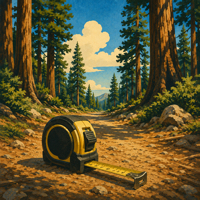
 A Measurement Decides a Trail’s Fate
Fifty inches. That’s the width of a bath towel laid out flat, or two dining chairs pushed together. It’s also the number a lawyer, not an engineer, chose twenty-five years ago to decide which off-road routes across 44 million acres of national forest are legally protected from repair and which ones aren’t. Twenty-five years.
Under 36 CFR 212.1, a motorized route over 50 inches wide counts as a road – unless the Forest Service has specifically designated and managed it as a trail. A route 50 inches or under is a trail, full stop. That single width threshold, buried in a federal regulation almost nobody arguing about this rule has actually read – most of them are too busy fighting over politics to notice inches – is the reason a washed-out jeep trail cut before Kennedy was president can sit closed and crumbling for twenty-five years while the agency that manages it is legally barred from bringing in the equipment or allowing trained trail crew volunteers to fix or maintain it.
This is the fight underneath the fight. Everyone arguing about the Roadless Rule – Sierra Club, Cal4Wheel, the Forest Service, the governors of three western states – is really arguing about which side of that fifty-inch line a given stretch of dirt falls on, and what happens to it once it does.
What the Rule Actually Does
The 2001 Roadless Rule bans two things across roughly 44 million acres of inventoried roadless national forest land: building new roads, and cutting timber, with a short list of narrow exceptions. On paper, it leaves grazing, hunting, fishing, and trails alone entirely.
In practice, it touches trails constantly – because a huge number of the routes off-roaders, hunters, hikers, anglers, and backcountry explorers all call trails were never formally designated as trails on a Forest Service travel plan. They’re old mining roads, old logging spurs, old fire access cuts, most of them older than the Rule itself – and in California, some of them older than statehood. Under the regulation’s own definition, an unclassified route over fifty inches wide that was never given trail status is legally a road. And roads under this Rule can’t be reconstructed. When one washes out, the agency’s only lawful options are to leave it broken or close it for good – which won’t stop every outdoor adventurist. The Rim Fire wasn’t started by someone who was following the Forest Service’s rules.
What Happened at Rim
In August 2013, a bow hunter lit an illegal campfire deep in the Clavey River drainage of the Stanislaus National Forest – a remote stretch of country he’d reached on foot, miles from the nearest road, during a fire restriction that banned open flames on the forest entirely. The fire escaped him on terrain he later said was almost vertical. Nine weeks later, it had burned 257,314 acres and become the third-largest wildfire in California history, reaching into Yosemite itself.
The ignition itself undercuts the “roads-cause-fires” narrative before the suppression story even starts. Rim began in the kind of remote, hard-to-reach country the Roadless Rule was supposedly written to protect, not at a trailhead or a pullout – proof that a lightning strike isn’t the only way a fire starts far from a road, and that distance from a road buys no immunity from a human ignition either.
What that same remoteness cost was the response. Official incident updates from that week describe direct-line suppression as impeded by difficult access and steep, inaccessible terrain – not a retrospective talking point, but what the assessment fire managers were working from in real time, as recorded in the incident’s own status summaries. Much of the ground that slowed crews down was inventoried roadless land, where the same road-reconstruction ban this piece has been describing left fewer access points for engines, dozers, and hand crews to reach the fire’s edge. The fire didn’t start near any road.
The Ignition Study Doesn’t Say What Sierra Club Says It Says
The Sierra Club’s argument sounds like a knockout: wildfires ignite four times more often near roads. Read the actual peer-reviewed article instead of the sensationalistic Sierra Club headline, and the number stops proving what Sierra Club wants it to prove.
The study behind that number – Aplet, Hartger, and Dietz, published in Fire Ecology in January 2026 – is real, peer-reviewed research, and it deserves to be treated as such rather than waved off. But look at what dataset it actually built. The authors combined the Forest Service’s own road network, Maintenance Levels 2 through 5, with Census TIGER/Line data covering interstates, county roads, and local roads. They excluded Maintenance Level 1 roads outright – the closed, unmaintained routes that make up a huge share of the legacy road inventory this fight is actually about. And nowhere in the methods does the motorized-trail layer appear. OHV, ATV, and 4×4 routes designated and managed as trails under 36 CFR 212.1 sit in a separate Forest Service GIS category from roads, and this study never touches that layer.
So the finding is real – or at least “real-adjacent” – but it’s also beside the point. It’s almost completely irrelevant. The study says ignitions cluster near pavement, gravel forest roads, and county roads. It says nothing – not a single data point – about the motorized trail network the Roadless Rule’s road-reconstruction ban actually constrains. Citing this study as proof that opening OHV trails increases fire risk is citing a study of a different road network to make a claim about a category it never measured.
Call it what it is. Sierra Club’s own campaign materials describe this in detail elsewhere – they know the difference between a Forest Service road and a Forest Service trail, because that distinction is the backbone of half the federal travel-management disputes their own chapters have weighed in on for twenty years. Presenting a study of paved and county roads as settled science on OHV trail ignitions is disingenuous, and the dataset itself is the evidence.
What “Local” Actually Looks Like
The Forest Service’s own rationale for this rescission asks for management to be moved closer to the ground, not for less of it. The National Forest Management Act already requires “coordination of outdoor recreation, range, timber, watershed, wildlife and fish, and wilderness” – coordination that a single nationwide prohibition, by definition, can’t do at the level of one forest, one watershed, or one fire-prone ridge.
The Stanislaus National Forest’s SERAL program is the working example. It integrates water-supply protection, tribal resources, community fire risk, and vegetation treatment into a single place-based plan – something a blanket rule covering 44 million acres from Alaska to Arizona was never designed to do. A national prohibition treats a fire-prone foothill community in Tuolumne County the same as an old-growth stand in the Tongass. SERAL doesn’t, because it can’t afford to.
The Ledger the Agency Didn’t Finish
The Forest Service’s own economic analysis of this rescission puts a number on what it might cost: $6.1 million a year in lost recreation benefits, up to $11.5 million in forgone passive-use value, a $9 million hit to recreation spending. Those are the agency’s own numbers, not an opponent’s guess.
What the same analysis never does is run the other side of the ledger. It credits “increased access for recreation” as a benefit of rescission in a sentence, then declines to put a dollar figure next to it anywhere in the actual table. Thousands of miles of legacy OHV and 4×4 routes sit closed or unrepairable under the current rule’s road-reconstruction ban. Reopening them has a value. Jeep and side-by-side shops feel it. So does the outfitter selling waders to the angler working the same drainage, and the gear shop stocking boots for the hiker headed up the same ridge. Motels in these towns fill up whether the season is OHV, deer, or trout, and the rural counties this analysis elsewhere admits depend on recreation revenue don’t much care which visitor is spending the money. The agency counted the cost of closing roads to hikers. It never counted what opening them is worth to everyone else who uses a national forest. An economic analysis that quantifies one side of an access tradeoff and leaves the other side as a sentence fragment is half an analysis, not a complete one.
This Has Happened Before
Rescinding a rule sounds, in Sierra Club’s language, like an attack. It’s also, legally, nothing new. The 2001 Rule was never a statute – Congress didn’t pass it, and no court has ever ruled it constitutionally or statutorily mandatory. It was issued the same way it can be undone: through notice-and-comment rulemaking under the Administrative Procedure Act.
The Tongass National Forest already ran this exact experiment twice. The Forest Service exempted the Tongass from the Roadless Rule in 2020, repealed that exemption in 2023, and – under Executive Order 14153 – reinstated it again in 2025. Three administrative reversals in five years, on the same 9.4-million-acre forest, under the same statutory framework. Whatever else that history proves, it proves the rule is not permanent, was never meant to be, and can be adjusted through the exact process now underway nationwide.
Trees Aren’t Republicans or Democrats
A lodgepole pine does not check a voter registration before it grows another ring. It burns exactly the same whether the signature on the executive order belongs to a Democrat or a Republican. The forest does not know who the president is, and it has no opinion on Secretary Rollins. That should matter to anyone arguing about how it gets managed – and for a lot of the loudest opposition to this rescission, it clearly doesn’t.
Look at how Sierra Club’s own chapters have framed this fight. The Wyoming chapter’s statement on the rescission carries the headline “Sierra Club: Republicans Use Wildfire Bill to Advance Attack on Roadless National Forest Lands.” Soil erosion doesn’t get top billing. Neither does any specific watershed. A political party does. Another Sierra Club release describes a Senate committee vote passing “on a party-line vote,” a phrase about arithmetic in the Senate, not conditions on the ground.
The National Resources Defense Council’s Garrett Rose goes further, calling the rescission part of a “deep-seated deregulatory ideology.” Forest health has a vocabulary – canopy density, fuel load, watershed yield. Rose chose the wrong words, and it led him to the wrong argument.
None of this means the underlying ecological questions don’t matter. It means a meaningful share of the loudest opposition to this rule is opposition to an administration first and a forest second – and a reader deserves to know the difference between an argument built on data and an argument built on which party currently occupies the White House.
Environmentalism Is Not Conservation
The two words get used like synonyms. They aren’t.
Conservation, in the tradition that built the Forest Service, means active management: cutting, thinning, burning, and building the access that makes those things possible, all aimed at keeping a working forest healthy over time. It’s the tradition of multiple use – timber, grazing, recreation, and watershed protection – balanced and adjusted at the local level as conditions change.
Environmentalism, as it shows up in this fight, means something closer to the opposite: keep people and equipment out, let the land alone, and treat any road or any cut tree as damage by definition. It’s a NIMBYism tantrum wrapped in politically-driven emotion, not a stewardship philosophy, and the data on what twenty-five years of that tantrum has done to these forests is unflattering.
The Forest Service’s own rationale for this rescission states plainly that the 2001 Rule “contributed to the lack of active management of the national forests, which has contributed to challenges in addressing forest health concerns.” That’s the agency responsible for these lands admitting that hands-off did not mean healthy.
The science backs it up. A 2024 meta-analysis in Forest Ecology and Management, drawing on data from 40 separate studies across the western United States, found that combined mechanical thinning and prescribed burns reduced subsequent wildfire severity by 62 to 72 percent compared to untreated forests. Untreated is exactly what a roadless designation guarantees. A forest left alone doesn’t stay pristine – it accumulates fuel, overcrowded stands, disease, and dead trees, year after year, until the fire that will ignite burns hotter and kills more of it than it would have otherwise.
Conservation manages a forest that can actually be called healthy – one built to survive drought, disease, and fire alike. Environmentalism, as practiced, has left millions upon millions of acres sickly and dying, waiting for the first spark to become a conflagration.
We Are All on the Same Side
Bringing Us Together
A hiker on a ridge trail, a hunter glassing a drainage at dawn, an angler working a creek below a washed-out crossing, and a Jeep club working its way up a rock shelf – none of them are on opposite sides of anything. They’re all people who left the pavement behind on purpose. The fight over this rule tries to divide them into camps that don’t actually exist on the ground.
Every one of those people is also, functionally, a warden. A hunter who spots an illegal dump site off a spur road reports it. A hiker who smells smoke where there shouldn’t be any calls it in before it becomes the next Rim Fire. An off-roader who finds a poached elk carcass tells a game warden. None of that happens on land nobody can reach. A forest that’s open, well-maintained, and full of people using it as intended is one that’s properly nurtured, stewarded, and cared for. It’s healthy public land, enjoyed and protected by its owners. Us.
Associations Make Us Stronger
The Golden State’s oldest off-road advocacy group, the California Four Wheel Drive Association, already proves this point in practice – its own members run Adopt-a-Trail programs, have maintenance agreements with the Forest Service, and show up with tools and equipment when a route needs work the agency can’t afford to do itself. That’s what access produces: people with a personal stake in a piece of ground showing up to take care of it.
The California Off Road Vehicle Association – CORVA – although slightly younger than Cal4Wheel, has an equally impressive résumé within the state. Stewards of the Sequoia, a CORVA-linked volunteer group, has spent more than two decades maintaining trails across the Sequoia National Forest and nearby BLM land – clearing thousands of downed trees, maintaining thousands of water bars, and brushing thousands of miles of trail that would otherwise have gone impassable. Its own volunteers aren’t just off-roaders. They’re hikers, hunters, anglers, campers, and horse riders, all doing the same work on the same ground, because the trail doesn’t ask what brought you there.
Keeping Us Apart
Sierra Club has an interest in keeping these camps separate. So do the gear companies selling one crowd a $600 pack and another crowd a $60,000 side-by-side, and so does any off-road group that raises money by framing every fight as us-against-them. None of those organizations are the ones actually standing in the mud at a washed-out crossing with their kids, wondering if the trail ahead is still passable. The people who are – hunters, anglers, hikers, off-roaders, everyone who’s ever loaded a truck before dawn to get somewhere the pavement doesn’t reach – aren’t fighting each other out there. They’re just trying to get from one place to the next, hoping the ground under them holds.
It’s the Forest, Stupid
A washed-out route in a national forest doesn’t know it’s fifty-one inches wide instead of forty-nine. It doesn’t know whether an agency planner in 1987 checked a box labeled “trail” or left the box blank. It just sits there, rutted and impassable, while the paperwork decides what happens to it next.
The question this Roadless Rule rescission actually answers isn’t who’s in the White House. It’s whether the people who manage 44 million acres of American forest get to fix what’s broken on the ground in front of them, or whether a width measurement written into a regulation twenty-five years ago gets the final word. Everyone standing on that ground – however they got there – is on the same side of the argument.
As the sun sets, the campfire crackles, and the scent of s’mores rises toward a sky full of stars, this fight isn’t us against them. It’s us for us. And in the end, it comes down to a battle of inches.
Rescind the Roadless Rule.
For more information on the Roadless Rule, check out:
Cal4Wheel’s Action Alert: Support Rescission of the Roadless Rule by Rose Winn, Cal4Wheel Natural Resources Consultant HERE
Blue Ribbon Coalition’s Roadless Rule Myths vs. Facts: Why Rescission Is Good for Forests and Access HERE
To submit a public comment on the Roadless Area Conservation proposed rule, go HERE
Further Reading
- USDA Forest Service, Draft Environmental Impact Statement on the proposed Roadless Rule rescission (2026)
- Federal Register, Notice of Intent, Vol. 90, p. 42179 (Aug. 29, 2025), and Proposed Rule, Vol. 91, p. 53827 (Aug. 20, 2026)
- USDA Forest Service, Economic Analysis (Regulatory Flexibility Act and Cost-Benefit Analysis) for the proposed rule
- Aplet, G.H., Hartger, P., and Dietz, M.S., “Three-decade record of contiguous-U.S. national forest wildfires indicates increased density of ignitions near roads,” Fire Ecology 22:8 (2026)
- Davis, K.T., et al., meta-analysis of thinning and prescribed fire effects on wildfire severity, Forest Ecology and Management 561 (2024)