

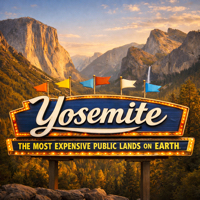
 Redirect existing revenue, fix the backlog, and keep parks open to everyone.
California boasts nine national parks — more than any other state — that are part of the National Park Service, which protects and manages the more than 10,000 acres of mountains, deserts, seashore, and old-growth forest. Those parks sit alongside numerous other National Park Service–managed units — national monuments, historic sites, preserves, and cultural landscapes — all part of the vast U.S. National Park System, which protects millions of acres under a range of designations.
The Interior Department’s new pricing policy, set to take effect Jan. 1, 2026, keeps the America the Beautiful annual pass — for now — at $80 for U.S. residents and ups the price to $250 for non-residents, and adds a $100 per-person surcharge for non-residents at 11 of the nation’s busiest parks. That’s not a minor tweak; it changes who can afford a trip, how families and tour groups plan, and what small towns that rely on park traffic can expect during peak seasons. Treating residency as a gate to a shared national resource deserves scrutiny.
Operationally, making residency a factor at park entrances adds friction where there should be flow. It means extra checks, more staff time, and new failure points in a system already unnecessarily stretched thin by heavy-handed federal budgetary restrictions. That complexity will slow entry, raise labor costs, and erode the visitor experience—especially during peak season when quick, predictable access matters most.
There’s an economic angle most policymakers should not ignore: gateway communities depend on the steady trickle of park visitors who rent rooms, catch dinner, buy gas, and hire guides. A $100 surcharge for each non-resident shrinks the pool of international visitors and makes multi-park travel pricier for families from abroad. Reduced visitation hits motels, outfitters, restaurants, and shuttle operators—businesses that play no role in federal fee policy but will absorb its fallout.
Beyond logistics and local economics, this policy sets a dangerous precedent. Calling it a non-resident surcharge treats park access like a social experiment: test public tolerance, watch behavior, then scale up. Pilot pricing for public goods and services rarely stays contained; public acceptance of this fee structure makes it easier to normalize expanded fees for other visitor groups — those of us who qualify for the current lower fees, as well as adding higher fees to more parks. Gradually, our public lands shift from a shared inheritance to a patchwork of paywalls set by ability to pay. The rule creates a policy pathway that favors revenue experiments over stewardship.
I remember the trajectory of Disneyland admission prices. I bought an Annual Passport years ago for something like $200, and it felt like a steal—no blackout dates and easy to use. Over time, the price climbed, blackout windows appeared, and special regional pricing showed up. Now the top-tier pass runs into the thousands of dollars, and some folks still call it a bargain because it promises perks and “exclusive” access. The point isn’t the exact numbers; it’s the psychology. You normalize higher cost by carving out tiers, framing limits as value, and courting a core of buyers who’ll tolerate worse terms because they feel they’re getting something special.
That’s the risk for parks. Start by charging non-residents more, watch the outrage fade, then broaden categories and locations. People acclimate fast. Once a premium becomes accepted for one group, it’s easier to justify other surcharges, blackout-style restrictions, or tiered access that rewards wealth or residency. What begins as a targeted surcharge will become a layered system of paywalls nobody planned for, but everyone eventually has to navigate. Initially, the loss will be felt by casual visitors, families on a budget, and small towns that rely on tourist dollars. Ultimately, though, the loss will be Americans’ access to public lands—what was once “America’s greatest idea” will now become “America’s largest no-trespassing area.”
The funding reality is simple: the National Park Service’s deferred maintenance backlog is roughly $23 billion. Meanwhile, tariff collections this year have totaled about $250 billion; redirecting less than 10% of that revenue would cover the entire backlog. That’s a policy choice, not a technical shortfall, and it could be done without alienating international visitors, saddling families with surcharges, or complicating park entry.
If we want durable solutions for funding, maintenance, and overcrowding, the right path is transparent impact studies, targeted conservation fees tied to specific projects, and investments in staffing and technology that actually speed access rather than complicate it. Asking the public to accept a residency-based pricing experiment without clear evidence of need, an enforcement plan, and mitigation measures is short-sighted. National parks work best when access is simple, predictable, and backed by stable funding—not when they become a testing ground for fee creep that ultimately harms all visitors and restricts public access to public lands.