

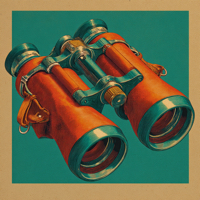
 Binoculars are the simplest upgrade you can carry that actually changes what you see. Get them set right and a distant ridge, a bird on the wing, or a marker across the water resolves into something useful instead of a tired blur. Most folks treat them like they’re just one knob and a wild guess — twist the center wheel, squint, and keep turning until frustration wins. That’s backward. Binoculars are a time-proven, compact, mechanical instrument that performs perfectly when the parts are tuned to you.
Binoculars are a handful of simple systems that do very specific jobs. Know what each part does, and you won’t be fiddling when the bird, marker, or Bigfoot shows up.
- Adjustable Eyecups — Collars that flip or twist around the eyepieces. They set eye relief and block stray light. Glasses on: eyecups down. Glasses off: eyecups up. A few millimeters can change comfort and the field of view.
- Diopter — A fine-tune ring (usually on the right eyepiece) that compensates for differences between your eyes. Set it once after focusing a single eye; it isn’t a range control.
- Focus Wheel — The big center wheel that sharpens both barrels together. After the diopter is set, this is the only control you should use to change range or track a moving subject.
- Barrels — The twin tubes that fold to match your interpupillary distance. Bring them together until the two images merge into one round field; if they never line up, the optics need service.
- Objective Lenses — The large front lenses that gather light. Bigger objectives = more low-light performance, but they need caps and care; grit and moisture are your binoculars’ enemy; they can ruin coatings faster than you think.
Tuning your view
Start with the fit. Bring the two barrels together until the left and right images merge into a single circular field — that sets the interpupillary distance. Next, sort the eyecups to suit whether you wear glasses; a proper eye-to-lens distance keeps the field full and the edges dark-free. Find a stationary target 20–30 yards away. Close or cover the right eye and use the center-focus wheel to nail the left eye razor-sharp. Now close the left eye and, without touching the center wheel, use the diopter ring to match the right eye to the left. From then on, the center wheel is your one-handed workhorse.
Hold them with two hands, tuck your elbows to your ribs, and breathe out before you lock on; steadiness beats brute force. For long watches or dim light, use a tripod adapter or a monopod — taking the shake out of the system makes details pop and saves your neck. Keep the eyecups appropriate to whether you’re wearing glasses: down for glasses, up for bare skin, and seat the barrels against your brow so the view centers and stray light is excluded.
Care matters. Blow grit off first, then wipe with a microfiber and optics cleaner. Store them dry and capped. Don’t adjust the diopter first — that’s the classic mistake. Set the barrels and eyecups, focus one eye, adjust the diopter, then trust the center wheel. Do that once, sitting on a bench or at the trailhead — before you begin your journey — and the glass stops being a heavy, clumsy device and becomes a really valuable tool — small, precise, and useful.
Now that you’ve got your binoculars set, I’ll see you — clearly, and from a long distance — on the trail!