

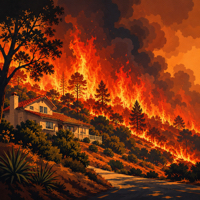
 Drive up into the foothills east of Redding, past the last gas station with cell service, and you’ll see them – empty lots where houses used to stand, driveways that lead to nothing but a chimney and a mailbox. Some of those lots have been empty since 2018. Not because the owners gave up. Because nobody would insure what they wanted to rebuild.
For most of the last decade, that’s been the story of wildfire country in California. Homeowners with clean records and defensible space, dropped anyway. Whole zip codes redlined by carriers who decided the math no longer worked. And a question that’s followed every one of those empty lots: will the private insurance market ever come back, or is California stuck propping up its own backcountry forever?
The short answer is that private insurers are already coming back. The longer answer explains why they left in the first place, and it starts with a law most Californians have never heard of.
Proposition 103 passed in 1988, and for decades it did real good – it forced insurers to justify their rates to a state regulator instead of setting whatever price the market would bear. But it also locked insurers into pricing coverage off historical loss data, backward-looking numbers from years that no longer resemble the fire seasons California actually has now. A wildfire model built on 1990s data has no idea what a 2020s Sierra foothill looks like in September. Prop 103 also barred insurers from passing along the cost of their own reinsurance – the backstop insurance companies buy to protect themselves from catastrophic losses – onto their customers. Reinsurance got dramatically more expensive as fires got worse. Insurers ate that cost themselves, with no way to price it into a policy.
Run that math for long enough and the outcome is inevitable. Insurers were writing policies in the highest-risk parts of the state at prices that didn’t reflect the actual risk, then absorbing the full cost when a fire came through and wiped out a decade of premiums in one season. State Farm and Allstate, among the largest carriers in the state, stopped writing new homeowner policies here entirely. Not as a warning shot. As a straightforward response to losing money on every policy they sold.
Homeowners who got dropped landed on the FAIR Plan, and this is where a lot of the public conversation goes sideways. People call it a government bailout, a taxpayer-funded safety net for people who chose to live somewhere risky. It isn’t that. The FAIR Plan is a syndicate – a pool funded entirely by the private insurers licensed to do business in California, built to guarantee that no homeowner in the state goes without basic coverage, even if no single company wants to carry that risk alone. It’s the insurer of last resort, not a state agency writing checks. Every dollar in it comes from the same private industry that pulled back from wildfire country in the first place.
Which brings us to what’s actually changing. California’s new Sustainable Insurance Strategy rewrites the deal. Insurers can finally use forward-looking catastrophe models instead of pure historical data, meaning they can price a home in the Sierra foothills based on what the fire risk actually looks like today, not what it looked like when Reagan was governor. They can also factor reinsurance costs into premiums, closing the gap that was bleeding capital out of every wildfire-zone policy they wrote.
In return, the state isn’t handing out a blank check. Insurers who want the new pricing flexibility have to commit to writing at least 85% of their statewide market share inside California’s designated wildfire-distressed areas. That’s the trade: better tools to price risk accurately, in exchange for a legal obligation to actually write policies in the places that need them, instead of cherry-picking the low-risk suburbs and walking away from everywhere else.
This is why insurers are starting to move back in rather than doubling down on the exit. A company that’s allowed to price risk honestly, and required to show up where the risk is highest, has a very different set of incentives than a company boxed into underpricing a burning hillside with no way to hedge against it. The regulatory bottleneck that pushed State Farm and Allstate out the door is the same bottleneck the Sustainable Insurance Strategy is built to unwind.
None of this means every homeowner in every canyon gets a policy at the same price they paid in 2015. Rates in the highest-risk zones will reflect the risk, and that’s going to be a hard adjustment for people who bought their home when the math looked different. Consumer advocates have raised real concerns about affordability, and about whether catastrophe models built by the insurance industry itself will be scrutinized closely enough by regulators. Those are fair questions, and the answer plays out over the next few fire seasons, not in a press release.
But the direction is clear. The state spent thirty-five years asking insurers to price wildfire risk with one hand tied behind their back, then wondered why they left. Untie the hand, and they come back – not out of charity, but because the math finally works again.