
Tag Archives: self-publishing

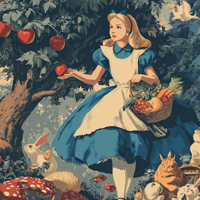
Today in Self-Publishing History: Alice’s Adventures in Wonderland – Lewis Carroll

On November 26, 1865 Charles Lutwidge Dodgson, under the pen name Lewis Carroll published the novel Alice’s Adventures in Wonderland.

From Wikipedia:

[Alice in Wonderland] … tells of a girl named Alice who falls down a rabbit hole into a fantasy world populated by peculiar, anthropomorphic creatures. The tale plays with logic, giving the story lasting popularity with adults as well as with children. It is considered to be one of the best examples of the literary nonsense genre. Its narrative course and structure, characters and imagery have been enormously influential in both popular culture and literature, especially in the fantasy genre.

Since the invention of the printing press – and becoming increasingly popular since the 19th century – many successful authors would create and publish their own works.  These self-published authors would gain more control of their work, earn greater profits, and eschew the practical bondage required by publishers.  Publishers have repeatedly attempted to frame these and other self-published authors as using “vanity publishing” in an attempt to shame them.  To be clear: most people can’t name a single publisher … but they can name MANY self-published authors.  And English classes don’t have assignments to read Random House or Penguin, but they do have assignments on Twain, Tennyson, Kipling, and Thoreau.
Continue reading

Fact: Self-publishing my non-fiction as ebooks makes sense

“Having registered that digital is the busy end of the business, I realised I could do more, and faster, on my own”
Anthony Hayward posted on The Guardian today about his adventures in self-publishing.  From the article:

Last year, ebook sales in the United Kingdom more than doubled, as did their share of the entire books market – to almost 15%. Despite an understandable reluctance on the part of many readers to join this revolution (and in time it might well prove to be that) ebooks are here to stay – so why not embrace them and discover the advantages?

As a journalist and author myself, I have done just that. After writing more than 20 books, with major publishers behind them, I have found it increasingly difficult to get new ideas accepted. It is also frustrating as a writer to have a non-fiction book that is up-to-the-minute when “completed”, only for it to come out maybe nine months later and seem slightly dated.

Continue reading

Bowkers continues to fight it’s growing marginalization by publishing silly fact-light statistics

Yes, another quarter … another weird Bowkers “report.”
On October 9, 2013, Bowkers issued a ‘report’ with gems like:

“…The analysis shows the growing prominence of a handful of companies that offer publishing services to individual authors.  More than 80 percent of self-published titles came to market with support from just eight companies, including Smashwords and CreateSpace…”

and

“…Ebooks continue to gain on print, comprising 40 percent of the ISBNs that were self-published in 2012, up from just 11 percent in 2007…”

You can read the whole “report” HERE.

It’s important to note, however, that ebooks sold through eRetailers like Amazon don’t require ISBN numbers.  The vast majority of ebooks on Amazon – the world’s largest retailer of ebooks – use ASIN numbers, which are Amazon’s own internal numbering system.

Continue reading

Success Stories – To Self-Publish or Not To Self-Publish…

USA Today Bestselling author, Kelli Maine writes about the pros and cons of self publishing:

Sometimes you have to take the plunge, but which direction do you go? Not too long ago, this question wasn’t considered valid by “the industry”. If you self-published, it was because you couldn’t get an agent or you couldn’t get an editor to buy your book. But today, the game has turned on its head. You don’t need an agent or an editor to get books in reader’s hands and be considered a legitimate author.

While some very successful self-published authors still seek the validity of having their names on a book in Barnes and Noble, know that getting stocked in a bookstore is NOT a guarantee from even the big six publishers. Take it from someone who has a YA published by a big six publisher and zero books in bookstores. They can’t necessarily sell your book to book buyers any better than you could.

With fewer and fewer brick and mortar stores and the ones that are still around carrying an equal number of t-shirts, toys and One Direction dolls as books, there’s an ever shrinking amount of shelf space and if you can suck in your gut and hold your breath, you might be able to squeeze in between Cassie Clare and Veronica Roth.

You can read the whole article HERE.


Amazon Source – the best of both worlds

Now customers don’t have to choose between eBooks and their favorite bookstore!

Indie bookstores can now work hand-in-hand with Amazon to confront the changing world of publishing.  Bookstore owners often see ebooks and ebook readers as an adversary – and Amazon as the ultimate evil and destroyer of bookstores worldwide.  That’s never been the case; without books and bookstores, Amazon wouldn’t exist.  To work with bookstores, Amazon has started a new program that offers discounted Kindle hardware and a percentage of future ebook sales to booksellers who sell the hardware.

Continue reading