

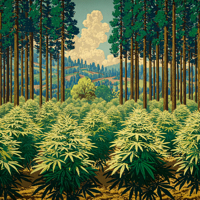
 As a big fan of our open spaces including national forest, state parks, and so on I firmly believe that using them to grow marijuana is a bad idea. It’s not that I’m against the plant in any way – I’m very 420 friendly – I just don’t believe public lands should be used to grow it. I’m a firm supporter of the Mendocino County, California’s yellow zip-tie program from a couple of years back. It was a great idea, and it’s a shame the state of California didn’t stand behind it and allowed the federal government to swoop in and wipe out the legal and law-abiding growers crops.
Being a conservationist and being cannabis friendly and living in a state where medical marijuana is legal, I was surprised to see that the unnecessary immigration reform bill includes ANYTHING having to do with pot or federal lands. It seems to me that a bill about immigration should be about … immigration.
From the Richmond Times-Dispatch:
The Senate recently approved a measure that would add — on top of the sentence for illegally growing marijuana — up to 10 years in prison for those cultivating the drug on federal land. The measure, a little-noticed addition to the immigration overhaul bill, also calls for new penalties for environmental damage such as that caused by the use of toxic chemicals.
 According to Science Daily, researchers at the Solar Observatory in Big Bear, CA have been taking some pretty detailed photos of the sun with their new solar telescope.
 Peter T. Hoss has penned an editorial for the Monterey Herald about the idiotic Draft Merced River Plan. In it, he lays out issues with the plan which I wholeheartedly agree with.
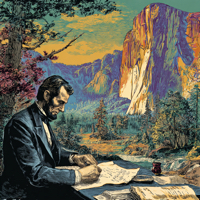 On this day in 1864 President Lincoln signed a bill drafted by both houses of the 38th Congress of the United States officially creating the Yosemite Grant. While Yellowstone ultimately became the first National Park, this was the first instance of park land being set aside for preservation and public use by the federal government. The grant was the result of citizens like Galen Clark and Senator John Conness advocating heavily for protection of the area. John Muir later led a successful movement to establish a larger national park encompassing not just the Yosemite Valley, but surrounding mountains and forests as well.
 With their usual regard for conservation and the environment, the Los Angeles Department of Water & Power (DWP)continues to display their professional ineptitude and scandalous behavior. All efforts to protect and restore Mono Lake have been undermined by the DWP since they made a unilateral power-grab of lake monitoring operations and started diverting $10,000,000 in water per year. Everything the DWP is doing is directly in violation of the rules set in 1998 by the State Water Board.