

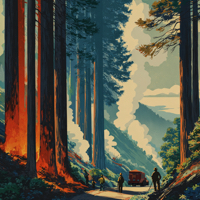
 California State Parks’ Program, Coordinated with CalFire — Recent Operations Focused in the Santa Cruz Mountains
California State Parks crews are continuing to conduct pile-burning work across the state. The most recent announcement is that they are targeting the Santa Cruz Mountains with pile burns planned across Big Basin Redwoods, Castle Rock, and Henry Cowell (including the Fall Creek unit). Operations are planned, as weather and air-quality windows allow, through April 2026. This is hands-on fuel reduction; not spectacle, not a shortcut, but a deliberate effort to remove the dry wood and brush fuel that can turn a lightning strike or a stray ember into a catastrophic, large-scale, landscape-devouring wildfire.
What Pile Burning Looks Like on the Ground
Crews collect the branches, small limbs, understory material, and any thinning or hazard-tree detritus and stack them into compact mounds. Each pile sits inside a cleared ring of bare soil, so flames don’t find a running start into surrounding fuels. Ignitions are timed for daytime windows — commonly between 8 a.m. and 5 p.m. — and only happen when wind, humidity, and air-quality forecasts indicate smoke will disperse away from communities. Once lit, piles are watched and patrolled until they’re cold; in some cases, smoldering can continue for days or weeks, and crews will return to mop up as needed.
What Residents and Visitors Should Expect
If you live near or plan to visit these parks, expect localized smoke and the sight of flame or glowing embers during active work. It’s normal for mild surface fire or low flame activity to occur between piles — managers sometimes allow this because it reduces the accumulation of additional fuels and lowers overall landscape risk. Park patrols may extend into the evenings and weekends when conditions warrant. Burns are coordinated with the regional air-quality agency and postponed when weather or air-quality conditions are unfavorable, so the schedule is flexible by design.
A Typical Pile Burning Exercise
On a recent stewardship day, park staff and volunteers spent hours hauling, raking, and cutting fallen branches from a campground-adjacent slope. They stacked the material into several tidy piles, kept the wood dry, and staged the piles for an approved burning window. The piles will be ignited only after CalFire gives sign-off and will be monitored until fully extinguished. This work — physical and unglamorous — is a scalable template used across both small and large parks throughout the state.
Why Managers Burn Piles Instead of Hauling Everything Away
Turning woody debris into heat, biofuel, chips, or biochar is a sensible, scientifically feasible option that is integral to a long-term conservation solution. But in steep, remote, or heavily broken terrain, the economics and logistics often don’t work: small-diameter material is bulky, transport is costly, and access is limited. Where hauling to a processing station isn’t feasible, carefully managed pile burning is the most practical way to remove hazardous fuel quickly at the scale land managers need to protect communities and key habitat.
How Pile Burning Fits With Ecology and Traditional Practices
Low- to moderate-intensity fire has been part of these forests for millennia. Many native plants respond positively to heat — shrubs resprout, some wildflower seeds germinate after fire, and redwoods tolerate light scorch and sprout vigorously from trunks and roots. Contemporary stewardship also draws from Indigenous “good fire” practices: small, controlled applications that mimic the low-intensity fires that historically maintained open understories and diverse habitat. When used selectively and under the right conditions, pile burning both reduces the chance of high-intensity wildfires and helps restore more natural patterns across the landscape.
Safety Realities and Tradeoffs
Pile burning is not risk-free. Smoke can affect breathing; managers pick burn windows to minimize impacts, but it’s a fire; smoke is inevitable. Nearby trees may be scorched — and while many trees tolerate substantial crown scorch (roughly two-thirds of the crown can be scorched without necessarily killing the tree), top-kill does occur when the crown is burned through. Crews accept limited, targeted tree mortality in exchange for removing far larger quantities of hazardous fuel that would otherwise amplify future fires. These operations include CalFire clearance standards, on-site suppression tools, and ongoing monitoring. When a forecast changes, patrol schedules are modified, or ignitions may be postponed.
Practical Guidance for Locals and Visitors
-
Check park notices and local air-quality forecasts before heading into Big Basin, Castle Rock, Henry Cowell, or nearby trailheads.
-
If you have respiratory issues, plan lower-intensity outings or a different day when smoke is present.
-
Keep pets indoors if smoke becomes noticeable and consider a simple paper mask for short exposures.
-
If you see uncontrolled fire behavior, contact your local fire agency; for questions about planned burns, use park contact lines.
Bottom Line
Pile burning is a strategic, science-informed conservation tool for removing fuels where hauling or conversion isn’t practical. It’s a compromise: imperfect, but often the most effective way to lower the odds of a catastrophic wildfire in steep, fuel-dense country. Stay informed, plan around smoke when necessary, and understand that these small, managed fires — lit only after CalFire and air-quality sign-offs are in place — are aimed at preventing the much larger conflagrations that no Californian wants to face.