
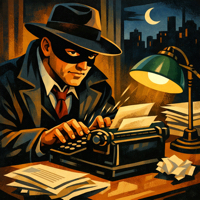
 I get inspired the same way I learned to write—by doing it. When I was a kid, I just wrote because nothing was standing between me and a blank page of onion-skin typing paper loaded into a Smith Corona typewriter.
In high school, two friends and I started a story in Mr. Canary’s American History class. I’d write a paragraph, then one of them would, then the other, and it kept going like that for two years across different classes and notebooks. That chain taught me that a story could live beyond a single voice and that momentum beats inspiration every time.
The habit stuck. After graduation, the writing didn’t stop; it showed up in odd places. As a software designer, I hid Easter eggs in code that other programmers found and laughed about. Eventually, somebody paid me for something I’d written. Then somebody else. No advertising — just word of mouth. Money followed the work, and with it came bigger rooms: Hollywood people asking for notes, screenplays to fix, manuscripts to ghost. I learned to separate the small, necessary hunger that kept me drafting from the louder demands of clients and commerce.
Now, I get inspired to write when I believe in the project, and the check clears. It sounds very mercenary, but if my name isn’t on the manuscript, then it might as well be on a cancelled check.
Do I need my name on everything I write? No, it’s not that important to me. I have a plaque on my desk from the Reagan Presidential Museum that reads, “There is no limit to what a man can do or where he can go if he does not mind who gets the credit.” That line nails it: aim for results, not applause. Put your head down, do the work, and let the work matter more than the byline. If the project moves people or solves a problem, the credit’s incidental; the effort is what counts.