

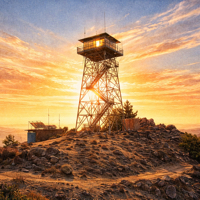
 Volunteers and towers still catch small ignitions early — a human, practical layer that many agencies have let lapse.
Human observers remain a reliable detection option when cell service is spotty, and cellphone networks are disabled by power shutoffs. Many rural ridgelines and backcountry roads have little or no cellular coverage, and utilities’ preemptive outages can render personal devices useless exactly when they’re most needed.
Fire lookout towers once formed a dense statewide watch. At their peak, there were thousands of towers nationwide – and, roughly, 600 in California alone, situated to give broad, unobstructed views across forests and foothills. That system thinned over decades as budget cuts reduced staff and closed sites.
By the early 2000s, state and federal agencies had removed much of the paid staffing to meet budget shortfalls; the move delivered immediate savings but also eliminated routine, local observation in many fire-prone corridors. Tragically, the law of unintended consequences played out: removing routine local observation eased budget pressures but paved the way for larger, far more destructive wildfires that cost lives, landscapes, and personal property – to the tune of hundreds of billions of dollars.
The U.S. Forest Service now concentrates seasonal lookouts in its far-north forests. Southern California lost nearly all its staffed state towers. Volunteers stepped into the gap. Each fire season, trained citizen observers staff multiple towers across the Angeles, Cleveland, and San Bernardino National Forests and support at least a dozen additional towers elsewhere in the state. This human presence adds thousands of watch hours per season and provides on-the-ground situational awareness that dispatchers can act on quickly.
New detection technologies, like ALERTCalifornia and the High Performance Wireless Research and Education Network (HPWREN), a University of California, San Diego project run by the Applied Network Research group, augment but are not a replacement. Cameras and satellites improve monitoring but produce false alarms, need verification, and often serve to track confirmed incidents rather than supply first reports. Case-by-case failures and disabled feeds have shown the limits of automated systems under real-world conditions.
Some states have chosen the opposite path, investing in new towers and restorations, funding multiple structures to ensure staffed coverage during high-risk periods. That model treats lookouts as complementary tools — human judgment partnered with modern sensors — rather than as relics to be retired.
A sensible plan for California is to pair grants and incentives with organized volunteer muscle to rebuild and reactivate historic lookouts. Create a restoration fund that awards matching grants to local chapters, off-road clubs, hiking organizations, and park partners for focused projects—installing new cabs on existing foundations, repairing towers, or rebuilding access roads. Match funding encourages local buy-in: chapters provide volunteer labor and equipment, the grant covers materials and licensed contractors, and land managers supply permits and on-site oversight. Require a stewardship plan and a small maintenance endowment for every award, so restored sites don’t slip back into disrepair.
Leverage stakeholders like Bass Pro Shops, REI, Jeep, Toyota, Ford, and GM, as well as off-road groups and hiking clubs, as paid or credited crews and donors for heavy work. Offer equipment-use incentives (fuel or trail-use credits, small equipment grants, or reimbursement for vehicle/tractor hours) and liability coverage assistance so clubs can contribute safely and reliably. Combine those incentives with formal “steward days” and multi-day build events where volunteers clear short stretches of fire road, stabilize tower approaches, and build skid-resistant platforms and steps. When heavy lifting or technical carpentry is needed, bring in state corps or CCC crews for the hard structural work; these crews can handle complex tasks, ensure compliance with safety and historic preservation standards, and accelerate timelines.
Make permitting and agency coordination part of the program design so projects move fast. Require an MOU with the managing agency (USFS, State Parks, or county) before funds are released, and use a simple checklist for environmental review, cultural resource clearances, and access agreements. Build training into the program: safe chain-saw use, erosion control, basic historic-preservation techniques, sustainable, safe, route/trail planning that minimizes impact on the natural environment, and tower-work safety. Pair volunteers with experienced crew leaders during construction and hand the site back with a clear operations plan—who manages the tower, how volunteers train and staff it, how shifts are scheduled, where replacement parts are sourced, and what routine inspections look like.
Measure success with simple, practical metrics: number of towers rehabbed, miles of access road cleared to safe standard, volunteer hours logged, and seasonal staffing coverage achieved. Publicize those wins to unlock more funding—local governments, utilities, and outdoor industry partners are more likely to invest when they see measurable returns: restored infrastructure, safer access, expanded detection coverage, and stronger community stewardship. This model stretches limited dollars, taps local capability, and turns existing foundations and trails into working lookout sites again—practical, affordable, and built to last.
Lookouts aren’t nostalgia. They are a low-cost detection layer that fills technology gaps, keeps eyes on the forest through volunteer organizations, and helps agencies channel suppression resources where they’ll do the most good. Reinvesting in California’s fire lookout towers is a straightforward, practical step toward faster initial attack and fewer large wildfire incidents.